
Yes, you can get homeowners insurance on your Florida home with aluminum wiring in two situations:
- Multi-strand aluminum wiring only — still used today on 220-volt circuits for HVAC, ranges, and dryers. This is current building code. All carriers accept it.
- Single-strand aluminum wiring that has been professionally repaired — using COPALUM connectors, AlumiConn connectors, or a full copper rewire.
However, even after single-strand repairs, only 6 of 17 Florida insurance companies will accept repaired aluminum wiring: Citizens, American Integrity, Tower Hill, Universal P&C, Progressive, and Geovera. The rest will decline — even if connectors were properly installed. Matching your home to the right company is just as important as making the repair. ee the full carrier chart below.
Can you insure a house with aluminum wiring in Florida? Yes, but only if the wiring has been properly repaired or replaced. And the insurance company you choose matters more than most homeowners realize.
We work with over 26 Florida home insurance companies. Some will cover homes with aluminum wiring once it has been remediated with approved connectors. Others will decline the home no matter what — even with a perfect repair. The chart below shows how 17 of those carriers handle aluminum wiring, based on our actual underwriting experience.
If your 4-point inspection flagged aluminum wiring, this guide will walk you through what it means, how to fix it, and which companies will write the policy once it is fixed.
Will Florida Insurance Companies accept Single Strand Aluminum Wiring?
No Florida insurer will approve a home with:
- Active single-strand aluminum branch wiring that has not been repaired (Read further, as some companies will accept remediated or repaired aluminum wiring)
- Partial or incomplete repairs
- Missing documentation from a licensed electrician
And many carriers — including AAA, Cypress, Edison, Florida Family, Florida Peninsula, Nationwide, Slide, Cabrillo/Safe Harbor, and Southern Oak — will not accept single-strand aluminum wiring under any circumstances, even with COPALUM or AlumiConn connectors.
This is one of the most common reasons homes fail a 4-point inspection — and one of the most common causes of policy declines or non-renewals in Florida.
What Is the Difference Between Single-Strand and Multi-Strand Aluminum Wiring?
Not all aluminum wiring is treated the same. Understanding the difference determines whether your home needs repairs at all.
Single-Strand Aluminum Wiring (Problematic)
Found in homes built roughly between 1965 and 1975. Used in branch circuits — outlets, switches, and lighting. It expands, contracts, and oxidizes over time, which can create loose connections and fire risk. The Consumer Product Safety Commission found that homes with this wiring are 55 times more likely to have fire hazard conditions than homes with copper wiring.
This is what insurance companies care about.
Multi-Strand Aluminum Wiring (Generally Acceptable)
Still used today for large 220-volt appliances including HVAC systems, ranges, and dryers. Made of multiple strands twisted together. It is code-compliant and does not require remediation or replacement. Most insurers accept homes with only multi-strand aluminum wiring.
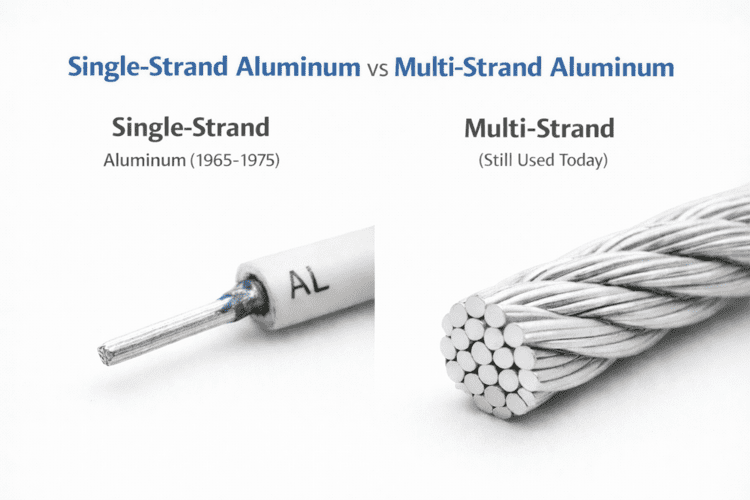
Single-strand aluminum wiring (left) is a known fire hazard flagged on 4-point inspections. Multi-strand (right) is still used today and accepted by most Florida insurers.
How Can You Tell If Your Home Has Aluminum Wiring?
Your home may have aluminum wiring if it was built between 1965 and 1975. Common signs include:
- Markings like "AL" or "ALUMINUM" stamped on visible wiring
- Flickering lights
- Warm or discolored outlets or switch plates
- Frequent breaker trips
The only reliable way to confirm is through a licensed electrician or a 4-point inspection. If your home was built in that era, we recommend having it checked before shopping for insurance — it saves time and avoids surprise declines.
Home Insurance with Aluminum Wiring: How Do You Fix Aluminum Wiring to Get Insurable Again?
There are three accepted repair methods. Each must be completed by a licensed electrician with full documentation for insurance purposes.
Option 1: COPALUM Crimp Connectors — Best Retrofit
Permanent copper-to-aluminum connection using high-pressure crimping. Considered the gold standard by many inspectors and carriers.
Option 2: AlumiConn Connectors — More Affordable
Uses set-screw connectors at each outlet and switch. Must be installed at every connection point.
Option 3: Full Copper Rewire — Permanent Solution
Replaces all aluminum wiring with copper. The most comprehensive fix. Opens up every carrier — including those that won't accept connectors.
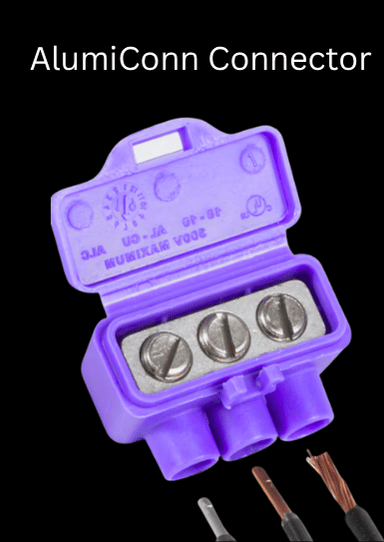
An AlumiConn connector — one of the approved methods for remediating single-strand aluminum wiring in Florida homes. Must be installed at every connection point by a licensed electrician.
Florida Homeowners Insurance Companies that Accept Aluminum Wiring
This is the question that matters most — and the one most articles never answer with real data. Which Florida homeowners insurance companies accept aluminum wiring? The chart below shows how 17 Florida insurance companies handle single-strand aluminum wiring on the electrical section of a 4-point inspection. These are actual underwriting guidelines from the carriers we place business with daily - not marketing material.
| Carrier | Single-Strand | With Connectors | Multi-Strand | Notes |
|---|---|---|---|---|
| Citizens | No | Accepted | OK | Single-strand requires connectors. Multi-strand accepted. |
| American Integrity | No | Accepted | OK | Single-strand requires connectors. |
| Tower Hill | No | Accepted | OK | Requires AlumiConn or equivalent connectors. |
| Universal P&C | No | Accepted | OK | AlumiConn and COPALUM both accepted. |
| Progressive | No | Accepted | OK | Accepted if corrected with COPALUM or connectors. |
| Geovera | No | Accepted | OK | COPALUM, AlumiConn, and pigtailing are accepted. |
| Monarch | No | No | OK | No single-strand even with connectors |
| Nationwide | No | No | OK | No single-strand even with connectors. |
| Olympus | No | No | OK | No single-strand even with connectors. |
| AAA | No | No | OK | No single-strand even with connectors |
| Cabrillo/Safe Harbor | No | No | OK | No single-strand even with connectors. |
| Cypress | No | No | OK | No single-strand, even with connectors |
| Edison | No | No | OK | No single-strand even with connectors |
| Florida Family | No | No | OK | No single-strand, even with connectors |
| Florida Peninsula | No | No | OK | No single-strand, even with connectors |
| Slide | No | No | OK | No single-strand, even with connectors |
| Southern Oak | No | No | OK | No single-strand even with connectors. |
Only 6 of the 17 Florida home insurance companies listed above will accept single-strand aluminum wiring with approved connectors. The rest require a full copper rewire — or they simply won't write the home. This is why the repair method you choose and the carrier you target need to match. Fixing the wiring is only half the equation.
This article is for informational purposes only and does not guarantee coverage from any carrier. Individual underwriting decisions depend on the full risk profile of the home. Carrier guidelines are subject to change — always verify with your insurance agent before making repair decisions based on a specific carrier.
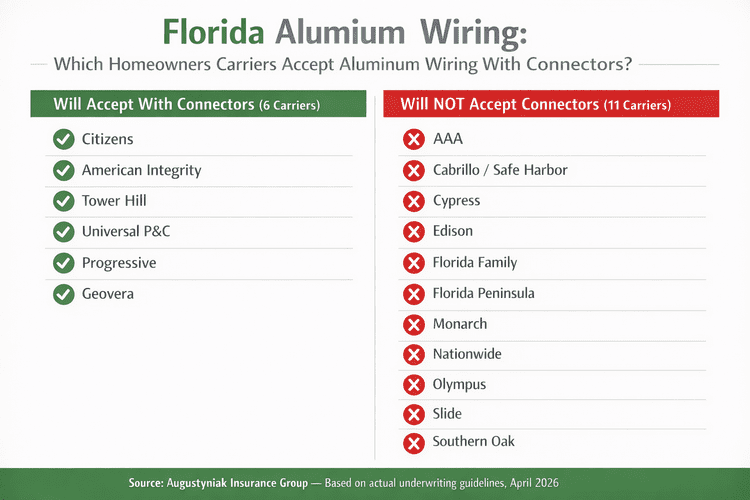
Which Florida homeowners insurance companies accept aluminum wiring with connectors? Based on actual underwriting guidelines — Augustyniak Insurance Group, April 2026.
Not sure where your home fits? We help homeowners sort through this every day. 904-268-3106 · Get a quote online
How Do You Find the Right Electrician for Aluminum Wiring Repairs?
The quality of the repair matters just as much as the repair itself. A poorly documented job can still result in a failed 4-point inspection — even if the work was done correctly.
Before hiring, ask:
- Do you have experience specifically with aluminum branch wiring?
- Are you certified for COPALUM installations?
- Will you provide signed documentation that includes the repair method, permit number, and inspection results?
- Will permits and local inspections be completed?
The documentation piece is critical. Many homeowners get the repair done correctly but can't get approved because the paperwork doesn't meet the carrier's requirements.
What Should You Do Before Shopping for Insurance?
- Confirm whether your home has single-strand or multi-strand aluminum wiring
- If single-strand, choose a repair method — and decide whether you want to target connector-friendly carriers or go with a full rewire to open up all options
- Get the repair completed with full documentation before requesting quotes
- Get a current 4-point inspection that reflects the completed work
- Work with an independent agent who knows which carriers accept which repair methods — this is where most homeowners lose time
Final Thoughts
Aluminum wiring does not automatically disqualify a home in Florida — but the path to coverage is narrower than most people expect.
With the right repair, the right documentation, and the right carrier match, many homeowners get strong homeowners insurance coverage without a full rewire. But as the carrier table above shows, more than half of the companies we work with won't accept connectors at all. That is the reality of this market.
If your home also has cloth wiring or knob and tube wiring, the rules are different — and often stricter. Our complete guide to Florida home insurance wiring issues covers all three.
The difference is not just fixing the wiring. It is knowing which companies will actually write the home — and having someone who works with all of them.

Susan Augustyniak is the owner of Augustyniak Insurance Group, an independent insurance agency based in Jacksonville, Florida. With decades of experience serving Florida homeowners, Susan believes in educating clients so they can confidently protect what matters most. Her team specializes in home, auto, umbrella, and business insurance — and works with more than 30 carriers to find the best coverage at the best value.
The carrier guidelines referenced in this article reflect our direct underwriting experience as of April 2026 and may change. Always confirm current guidelines with your agent.
This article is for informational purposes only and does not guarantee coverage from any carrier. Individual underwriting decisions depend on the full risk profile of the home.
Frequently Asked Questions About Aluminum Wiring and Florida Home Insurance
Can I get homeowners insurance in Florida if my home has aluminum wiring?
Yes, but only if the single-strand aluminum branch wiring has been professionally repaired using COPALUM connectors, AlumiConn connectors, or a full copper rewire. No standard Florida insurer will write a policy on a home with active, unmodified single-strand aluminum wiring. Even after repairs, only 6 of 17 major Florida carriers will accept connectors — the rest require a full rewire or will decline the home entirely.
What is the difference between single-strand and multi-strand aluminum wiring in a home?
Single-strand aluminum wiring was used in branch circuits (outlets, switches, lighting) in homes built between 1965 and 1975. It is a known fire hazard because it expands, contracts, and oxidizes at connection points. Multi-strand aluminum wiring is still used today for large 220-volt appliances like HVAC, ranges, and dryers. Multi-strand is code-compliant, considered safe, and accepted by most Florida insurers without remediation.
How much does it cost to repair aluminum wiring in a Florida home?
COPALUM crimp connectors typically cost $3,500 to $8,000 depending on home size. AlumiConn connectors range from $1,500 to $5,000. A full copper rewire — the most comprehensive solution — runs $12,000 to $20,000 or more. All work must be completed by a licensed electrician with permits filed, inspections completed, and signed documentation provided for insurance purposes.
Which Florida insurance companies will cover a home with aluminum wiring after repairs?
Based on current underwriting guidelines, six carriers accept single-strand aluminum wiring with approved connectors: Citizens, American Integrity, Tower Hill, Universal P&C, Progressive, and Geovera. Eleven carriers will not accept connectors under any circumstances: AAA, Cabrillo/Safe Harbor, Cypress, Edison, Florida Family, Florida Peninsula, Monarch, Nationwide, Olympus, Slide, and Southern Oak. A full copper rewire eliminates the issue with all carriers.
What happens if my 4-point inspection fails because of aluminum wiring?
If a 4-pooint inspection identifies single-strand aluminum wiring, most insurers will decline or non-renew the policy. To get covered, you will need to have the wiring professionally remediated, obtain signed documentation from a licensed electrician, including permit numbers and photos, get a new 4-point inspection showing the completed repairs, and then apply with a carrier that accepts your specific repair method.
Will Florida insurance companies accept AlumiConn or COPALUM connectors?
Some will, some won't. Citizens, American Integrity, Tower Hill, Universal P&C, Progressive, and Geovera accept both AlumiConn and COPALUM connectors when installed at every connection point by a licensed electrician with full documentation. However, the majority of Florida carriers — including AAA, Cypress, Edison, Slide, and Southern Oak — will not accept any type of connector regardless of repair quality.
Do I need a full copper rewire to get homeowners insurance in Florida?
Not necessarily. If you target a carrier that accepts connectors (like Citizens, Tower Hill, or Universal P&C), an approved connector repair may be sufficient and far less expensive. However, if you want access to every carrier — or if your home has other risk factors like an older roof — a full copper rewire eliminates the wiring issue entirely and gives you the widest range of options.
How do I know if my Florida home has aluminum wiring?
Homes built between 1965 and 1975 are most likely to have single-strand aluminum wiring. Look for "AL" or "ALUMINUM" stamped on visible wire insulation, and watch for warning signs like flickering lights, warm or discolored outlet plates, and frequent breaker trips. The only reliable confirmation is through a licensed electrician or a 4-point inspection.
Can I buy a house with aluminum wiring in Florida and still get insurance?
Yes, but plan for the remediation cost before closing. Many buyers negotiate the repair into the purchase agreement or request a credit from the seller. Have the wiring remediated before applying for homeowners insurance — not after. Get the repair documented with permits and a clean 4-point inspection, then work with an independent agent who can match you to a carrier that accepts the repair method used.
Is aluminum wiring an automatic deal-breaker for Florida home insurance?
No — but unrepaired aluminum wiring is. No Florida carrier will insure a home with active, unmodified single-strand aluminum wiring. Once properly remediated with approved connectors or a full rewire, coverage is available through multiple carriers. The key is matching the repair method to a carrier that accepts it, which is why working with an independent agent who knows the underwriting differences saves significant time.
Have aluminum wiring on your 4-point inspection? We help homeowners work through this every day — confirming whether repairs meet underwriting guidelines and matching you with companies that will actually consider the home. 904-268-3106 · Request a quote