
- 2,250+Five-Star Reviews
- 80+Insurance Companies
- 20+Years in Florida
- 4.9★Google Rating
We are Augustyniak Insurance Group, an independent insurance agency in Jacksonville. We've been helping Florida drivers find the right auto coverage for over 20 years. If you've just hit a deer and need to talk through your claim, call us at (904) 268-3106. If you want to understand exactly what to do first, keep reading.
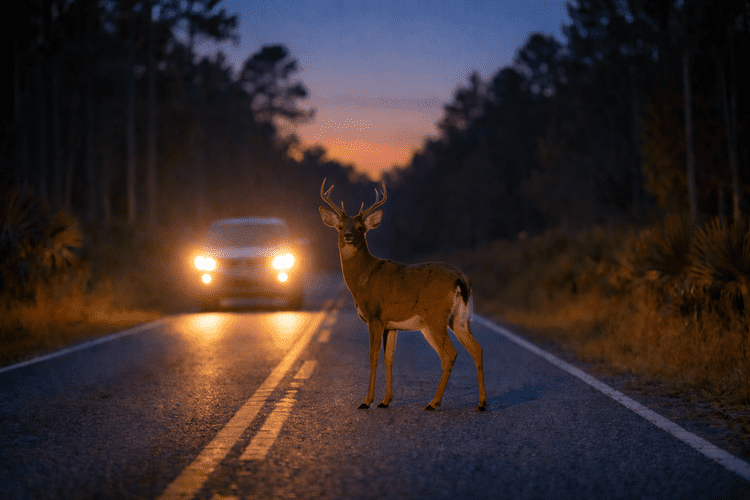
It happens faster than you can react. One second the road is clear. The next, there is a deer in your headlights and the sound of impact.
Most people picture this happening in Michigan or Pennsylvania. But Florida has an estimated 542,000 white-tailed deer statewide, according to the Florida Fish and Wildlife Conservation Commission (FWC), and they live in every county surrounding Jacksonville: Nassau, Clay, St. Johns, and Duval. Suburban growth keeps pushing development into deer habitat. The roads follow. The deer don't move.
State Farm logged more than 1.7 million animal-related auto claims nationwide between July 2024 and June 2025. Florida drivers are part of that number, especially October through December, when the breeding season puts deer on the move at dawn and dusk.
Here is exactly what to do, step by step.
1 Pull Over and Turn On Your Hazards
Your first job is to get out of traffic. If the car is drivable, move it to the shoulder or a safe pull-off. Turn on your hazard lights immediately so other drivers can see you.
If you cannot move the vehicle, stay inside with your seatbelt on and call 911. A car stopped in a travel lane on a dark road is a serious secondary hazard.
2 Do Not Approach the Deer
This is the most common mistake people make, and it can cause serious injury.
A deer that looks dead or stunned can kick with enough force to break bones. A wounded deer can stand suddenly and run in any direction. They are frightened, disoriented, and unpredictable. Let the animal be.
Keep your distance. If the deer is in the road and blocking traffic, call the Jacksonville Sheriff's Office non-emergency line at (904) 630-0500. Officers or animal control will handle the animal. If the situation creates an immediate hazard to other drivers, call 911.
3 Call the Police: Know When It's Required
In Florida, you are required to report a crash to law enforcement if it involves injury, a fatality, or property damage exceeding $500 (Florida Statute 316.066). A deer strike that damages your hood, bumper, or windshield will almost certainly cross that threshold.
Even when not legally required, a police report is worth getting. It documents the time, location, road conditions, and the fact that a deer was involved. Your insurance company will want that record. Some companies require it to process the claim.
4 Document the Scene Before You Move Anything
Good documentation is the difference between a smooth claim and a disputed one. Take photos of everything while you are still at the scene.
What to photograph
- All four sides of your vehicle, not just the point of impact
- Close-up of every damaged area
- The deer, if visible and safe to photograph from a distance
- Road conditions, skid marks, and the area where the deer came from
- Any deer hair, blood, or fur on the vehicle or road (this is evidence)
- Street signs or mile markers to confirm the exact location
Write down the time, weather conditions, your speed before impact, and the direction you were traveling. If another driver stopped to help, get their name and contact information.
5 Check Whether Your Car Is Safe to Drive
A deer strike can look like cosmetic damage and hide something much more serious. Even at moderate highway speeds, an impact with a large animal can shift structural components, crack the radiator, or damage sensors that show nothing obvious from the outside.
Before you drive away, check for:
- Leaking fluid under the vehicle (coolant, oil, or transmission fluid)
- Hood that will not latch fully
- Broken headlights or taillights
- Tire or wheel damage from impact or emergency braking
- Airbag deployment. If bags deployed, do not drive the car
- Engine overheating warning on the dashboard
If anything seems off, call for a tow. Driving a compromised vehicle can cause additional damage that may not be covered under the original claim.
Not Sure If Your Policy Covers a Deer Accident?
Before you file a claim, talk to a local agent who can tell you exactly what applies and what to watch out for. No pressure. Just answers.
Talk to a Local Agent Call (904) 268-3106 Augustyniak Insurance Group · Jacksonville, FL · Mon–Fri 8:30am–5pm6 Call Your Insurance Company
Here is the piece most people get wrong: hitting a deer is a comprehensive claim, not a collision claim. That distinction matters more than most drivers realize.
Comprehensive coverage is designed for events outside your control: animal strikes, storms, theft, fire, and vandalism. Collision coverage applies when your vehicle hits another vehicle or a fixed object. A deer is neither.
When you call your insurer:
- Have your policy number ready
- Share the police report number if you obtained one
- Send photos digitally through the insurer's app or portal
- Ask what your deductible is before approving any repairs
- Ask whether the insurer has preferred repair shops. Some come with a guarantee on the work
Florida requires every driver to carry Personal Injury Protection (PIP). That coverage pays 80% of your medical bills up to $10,000 after any crash, regardless of who caused it. It does not pay for your car. Vehicle repair after a deer strike falls on comprehensive coverage, not PIP.
Which Coverage Applies When You Hit a Deer?
| Coverage Type | Covers Deer Strike? | What It Does |
|---|---|---|
| Comprehensive | Yes | Covers animal collisions and other non-collision events. You pay your deductible; the insurer pays for repairs up to what your car is worth on the market. |
| Collision | No (deer hit) | Applies if you swerve to avoid the deer and hit another object or vehicle instead. |
| Liability | No | Covers damage you cause to others. Does not cover your own vehicle. |
| PIP (required in FL) | Yes, for injuries | Pays 80% of medical bills up to $10,000 for you and your passengers after any crash, regardless of fault. |
| MedPay (optional) | Yes, for injuries | Helps cover medical costs that PIP doesn't pay. Not required in Florida. |
If you carry only Florida's required minimums (liability and PIP), you have no vehicle damage protection after a deer strike. All repair costs come out of pocket. For a full breakdown of how these two coverages work and what each one costs to add, see our guide on comprehensive vs. collision auto insurance in Florida.
Comprehensive coverage is typically inexpensive relative to what it protects. If you drive wooded or rural roads around Jacksonville and don't carry it, it is worth a conversation with our team.
Does Filing a Deer Claim Raise Your Insurance Rate?
Generally, no. Insurance companies treat hitting a deer the same way they treat hail damage or a tree falling on your car. Something that was not your fault and could not have been avoided.
A deer claim will not go on your Florida driving record as an at-fault accident. That said, filing several comprehensive claims in a short period (deer, then hail, then a theft) can still affect your rate at renewal depending on your insurance company. One claim is rarely a problem.
One thing to watch: if you swerved to avoid the deer, missed it, and hit another driver's vehicle, that is a different situation. You may be considered at fault for that crash, and it would be handled differently by your insurer.
What Happens If You Hit a Deer With Liability-Only Coverage?
Florida only requires two coverages: liability and PIP. Neither pays for damage to your own vehicle.
Liability pays for damage you cause to someone else. PIP covers your medical expenses up to $10,000 after any crash. Neither covers your car after a deer strike.
If you carry liability only and you hit a deer, every repair comes out of pocket. A caved-in hood, a cracked radiator, a broken windshield. All of it. There is no claim to file for vehicle damage.
What If the Deer Ran Away?
File the claim anyway. The deer does not need to be at the scene for your comprehensive claim to be valid.
What matters is that your vehicle was damaged. Photos of the damage, a police report if you obtained one, and physical evidence on the car (fur, blood transfer, a scrape from an antler) all support your claim.
Florida Statute 316.066 requires reporting any crash with injury or property damage over $500, whether or not the animal is present. Don't wait to see if the damage "gets worse." Most policies require timely reporting, and waiting too long can limit your options when you do file.
Why Deer Accidents Happen Around Jacksonville
Florida has roughly 542,000 white-tailed deer per FWC estimates, and every county surrounding Jacksonville has active deer populations. Development keeps pushing roads deeper into their habitat. That is where the risk concentrates.
The highest-risk corridors in the region:
- Nassau County: US-1 and SR-200 near Yulee and Callahan, where pine flatwoods meet the road edge
- Clay County: Blanding Boulevard near Camp Blanding and rural stretches of CR-218
- Western Duval County: Normandy Boulevard and Old Middleburg Road, bordering Jennings State Forest
- St. Johns County: rural roads south and west of the city near Hastings
Risk peaks October through December, the rut. Male deer are moving faster and farther. Dawn and dusk are the most dangerous windows, but a deer can cross any road at any hour.
If you see one deer, expect more. They travel in groups. Slow down and scan both shoulders before accelerating.
How to Reduce Your Risk of Hitting a Deer
You cannot eliminate the risk. But you can make choices that reduce it significantly.
- Use high beams on rural roads when safe.
High beams extend your reaction distance and make deer eyes visible earlier. Switch to low beams for oncoming traffic. - Slow down through wooded areas at dawn and dusk.
Speed is the main factor in severity. Even 5 to 10 mph slower gives you meaningfully more stopping distance. - Do not swerve aggressively.
Braking hard and holding your lane is safer than swerving. A swerve that causes you to hit another vehicle or leave the road often results in a worse accident than the deer strike itself. - Take deer crossing signs seriously.
They are placed based on documented wildlife movement data. If a sign is posted, deer have already been hit there. - Watch for reflective eyes on the shoulder.
A flash of light at ground level on a dark road is worth slowing down for.
Frequently Asked Questions
Does hitting a deer count as an at-fault accident in Florida?
No. Wildlife collisions are treated as not-at-fault events by Florida insurers. The claim is filed under comprehensive coverage, not collision, and it will not appear on your driving record as an at-fault accident.
What if I hit a deer but my car has no visible damage?
Still document the incident. Some damage is not visible from the outside. A radiator, frame member, or sensor that was jostled may cause problems later. Some policies also have time limits on reporting. Filing now protects you even if the repair turns out to be minor.
Can my car be totaled by hitting a deer?
Yes. If repair costs exceed the vehicle's actual cash value, the insurer will total it and pay out that value minus your deductible. Smaller sedans are more vulnerable to total-loss outcomes than larger SUVs and trucks.
Do I need comprehensive coverage to be protected?
Yes. Florida requires only liability and PIP. Neither covers your vehicle in a deer strike. Comprehensive is optional. Without it, deer damage comes entirely out of pocket.
Will my rate go up after filing a deer claim?
In most cases, no. It depends on your insurance company. Hitting a deer is generally treated as an unavoidable accident, not something you caused. One comprehensive claim typically does not raise your rate. If you are concerned, ask your agent before you file so you understand what to expect.
Compare Auto Coverage Across 80+ Carriers
If your current policy would leave you paying out of pocket after a deer strike, fill out the form below. We'll run your information through 80+ companies and get back to you with options, often same day or next business day.
Prefer to Talk to a Person?
Our team is here Monday through Friday, 8:30 AM to 5:00 PM. No phone trees. Real people who know Florida auto insurance.
Call (904) 268-3106 Augustyniak Insurance Group · 12058 San Jose Blvd, Jacksonville FL
Susan Augustyniak, CIC
Vice President, Augustyniak Insurance Group
Certified Insurance Counselor with 25+ years in the industry. Before joining Augustyniak Insurance Group in 2008, Susan spent nine years at Nationwide Insurance as a commercial underwriter, large loss property claims adjuster, and sales manager. She holds a Florida 2-20 General Lines Agent license and helps Jacksonville drivers navigate coverage decisions across Duval, St. Johns, Clay, and Nassau counties.
Published April 2026. Last reviewed April 2026.
The information in this article is for general educational purposes. Coverage, claim outcomes, and rate impacts vary by carrier, policy, and individual circumstances. Always review your own policy and speak with a licensed agent before making coverage decisions. Augustyniak Insurance Group is a licensed independent insurance agency in the state of Florida.