
Updated April 2026

What Does an Auditor Actually Look for During a Workers' Comp Audit?
Getting notice of a Florida workers' comp audit can feel stressful, but it does not have to be. The auditor is checking four things: your payroll, your subcontractors, your officer exemptions, and whether your employees are classified correctly.
If you know what they are looking for, you can prepare ahead of time and avoid unexpected costs. This checklist walks you through it. For background on coverage itself, see our Florida workers' comp insurance guide.
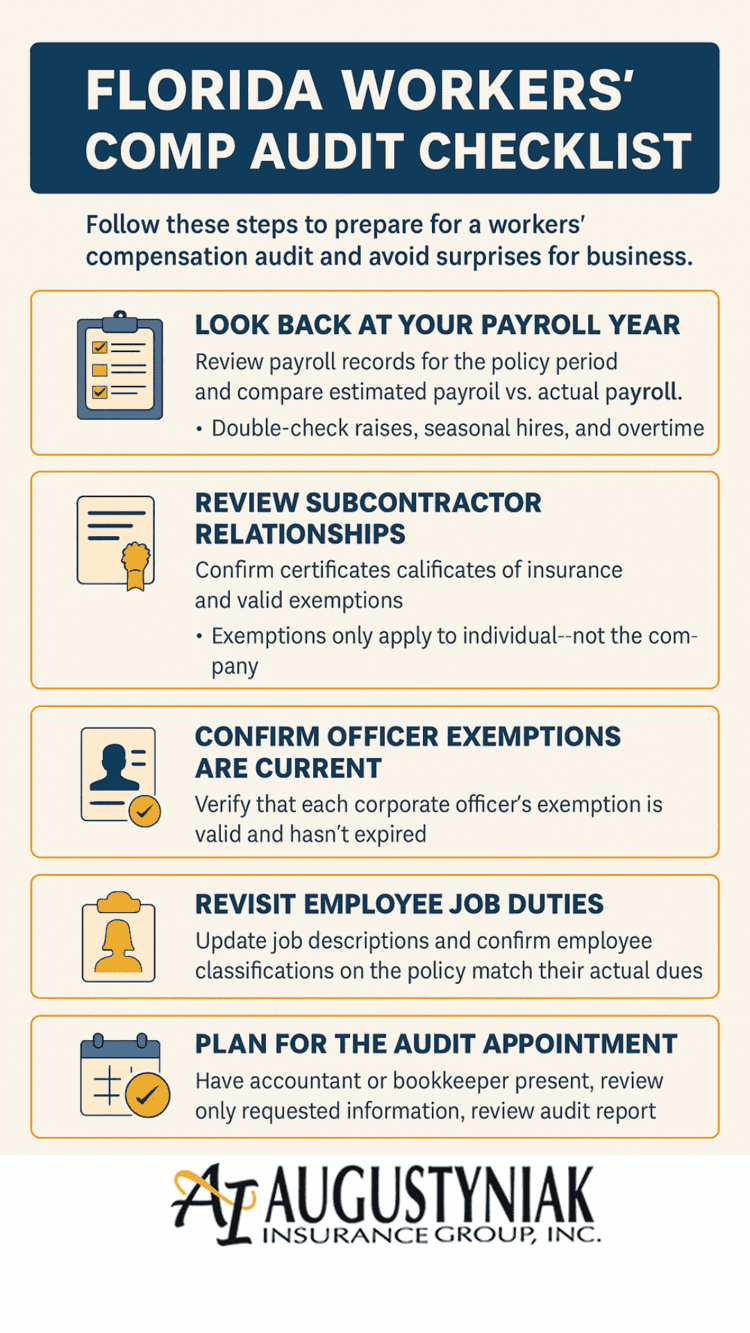
(1) Review your payroll for the exact policy period.
(2) Gather subcontractor certificates of insurance or exemptions.
(3) Confirm all officer exemptions are current.
(4) Verify employee job duties match their NCCI class codes.
(5) Organize your documents and assign one contact for the auditor.
1 Look Back at Your Payroll Year
Think of the audit as a "true-up." The insurance company wants to compare your estimated payroll to your actual payroll for the policy year.
Review payroll records for the exact dates of your policy period, not the calendar year. Many businesses run payroll January to January, but their workers' comp policy may cover different dates.
Example: You estimated $100,000 in payroll. Actual payroll came in at $120,000. You will owe additional premium. If it came in at $80,000, you may get a refund.
Documents to Gather
- IRS 941 quarterly payroll reports
- Payroll records from QuickBooks, Gusto, ADP, or other payroll software
- W-2 and 1099 forms for the policy year
- Overtime and bonus records
Having these ready makes your audit smoother. Your bookkeeper or accountant is a great resource here.
2 Review Subcontractor Relationships
One of the biggest audit surprises comes from subcontractors. You hire a sub who does not carry their own workers' comp. The auditor adds their pay to your payroll, and you get charged premium on it.
That is why keeping subcontractor certificates of insurance on file is critical. If you are not sure how to check, here is our guide on how to verify a Florida subcontractor's workers' comp coverage using the state database.
Documents to Gather
- A list of all subcontractors paid during the policy year
- Certificates of Insurance showing valid workers' comp for each sub
- If a sub claimed an exemption: their individual exemption certificate from the State of Florida
3 Confirm Officer Exemptions Are Current
In Florida, officer exemptions expire every two years. If an exemption expired mid-policy, the officer's wages could be added to payroll, even if you assumed they were exempt the whole time.
Use the Florida exemption database to check status before your audit.
Documents to Gather
- Each officer's exemption certificate showing it was valid during the entire policy period
- Renewal confirmations if the exemption was renewed mid-year
- Corporate officer list from Sunbiz or your corporate filings
Need Help Preparing for Your Audit?
We walk clients through this every day. Call us and we will review your class codes, payroll records, and subcontractor documentation before the auditor does.
Call (904) 268-3106 Augustyniak Insurance Group · Jacksonville, FL · Mon–Fri 8:30am–5pm4 Revisit Employee Job Duties
Auditors compare what your employees actually did with how they were classified on the policy. If you classified someone as "clerical" but they were regularly out on job sites, that is a higher-risk category and a higher premium.
How NCCI Class Codes Affect Your Audit
In Florida, job classifications are managed by the National Council on Compensation Insurance (NCCI). Each type of work gets a class code that determines its rate. If an employee's duties changed during the year, the auditor may adjust the code. To see how class codes affect your cost, visit our workers' comp insurance page for the full 2026 rate table.
- Clerical roles carry low-risk codes and low rates.
- Field roles like electrical, HVAC, plumbing, and landscaping carry higher-risk codes.
- Misclassification is one of the most common sources of surprise premium changes at audit.
Documents to Gather
- Job descriptions for all employees
- Timesheets or schedules showing primary duties and locations
- Org chart or departmental list showing who does what
- Any written role changes made during the year
5 Plan for the Audit Appointment
Whether your audit is by phone, online, or in person, a little preparation saves headaches.
- Have your bookkeeper or accountant on standby.
They know where the reports are and can answer detailed payroll questions quickly. - Provide only what is requested.
Extra information can confuse the process or create new questions. - Review before you sign.
Look for errors in payroll totals, classifications, or subcontractor entries. Auditors can make mistakes too. - Keep copies.
Save a digital copy of everything you send for your own records. - Ask questions.
If something does not look right, speak up before you sign.
You Are Ready for Your Audit
The key to a smooth Florida workers' comp audit is thinking like the auditor: payroll, subcontractors, exemptions, and job duties. Cover those bases and you will avoid surprises.
If you need help preparing for your audit or want a second opinion on your policy, give us a call. Augustyniak Insurance Group has over 2,250 Google reviews and writes workers' compensation policies across Florida and Georgia. We will review your class codes, verify your payroll, and make sure you are not overpaying.
For a deeper look at how your premium is calculated, including the 2026 NCCI Florida rate table for 25+ class codes, see our full Florida workers' comp insurance guide.
Ready to Review Your Workers' Comp Policy?
We compare carriers, verify class codes, and help you prepare for audits. One call gets you started.
Get a Workers' Comp Quote No obligation. Most quotes returned same day or next business day.
Susan Augustyniak, CIC
Vice President, Augustyniak Insurance Group
Certified Insurance Counselor with 25+ years in the industry. Susan leads the Augustyniak Insurance team in Jacksonville, helping Florida businesses navigate workers' compensation audits, classification, and compliance. Published September 2025. Last reviewed April 2026.
Frequently Asked Questions
What documents should I gather before a workers' comp audit?
Payroll summaries, W-2s and 1099s, overtime and bonus records, job descriptions, and subcontractor certificates or exemptions for the full policy period.
How do NCCI class codes affect my premium?
NCCI class codes assign a risk level to each job type. If actual duties differ from what is on your policy, the auditor may reclassify employees, which can raise or lower the premium.
What if a subcontractor did not have coverage?
If a sub lacked workers' comp or a valid exemption, payments to that sub may be added to your payroll for premium calculation purposes at audit.
Can I get an extension if I am not ready?
Often yes, but you must request it from your carrier before the deadline. Do not ignore audit notices. Penalties can include cancellation or maximum payroll charges.
How long does a workers' comp audit take?
Telephone or online audits can take under an hour if records are organized. In-person audits vary by business size and complexity.